How Tilavon Keeps Your Salon Fully Stocked
How this feature helps your salon succeed
Never Run Out
Low stock alerts ensure you always have essential supplies on hand.
Reduce Waste
Track usage patterns to order the right quantities.
Save Ordering Time
Quick reorder from supplier history speeds up purchasing.
Cost Control
Track costs and margins on every product you sell or use.
Complete Inventory Tracking Capabilities
Our salon inventory management & supply tracking feature includes everything you need to manage this aspect of your salon efficiently.
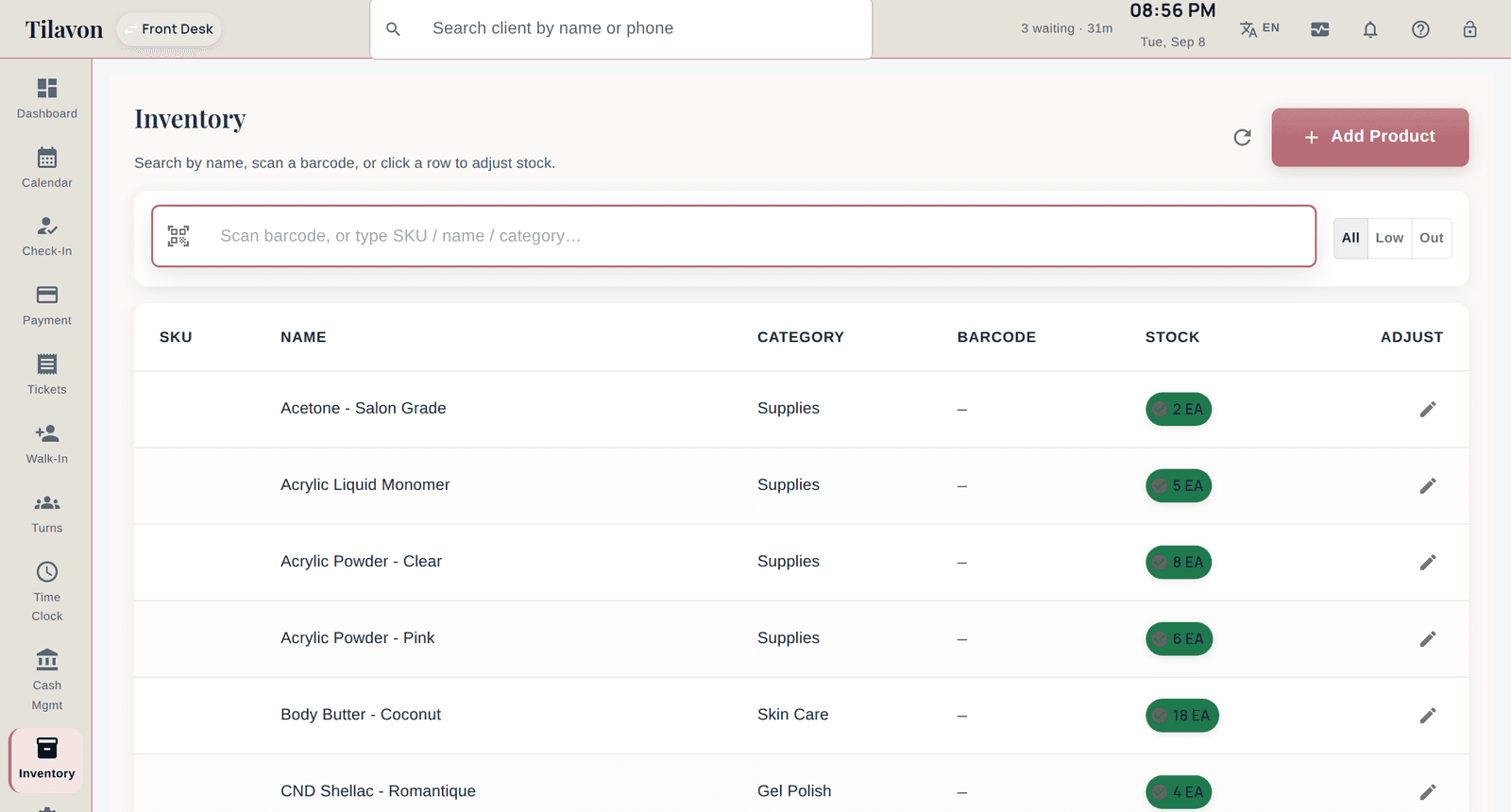
- Product catalog with images and details
- Automatic low stock alerts
- Purchase order management
- Supplier contact and pricing
- Cost tracking and margin analysis
- Barcode scanning support
- Usage tracking per service
- Inventory auditing tools
- Vendor management with delivery tracking
- Expense tracking and categorization for budgeting
- Barcode generation and label printing for retail products
- SKU variant management for size, color, and brand
- Stock count workflows with discrepancy reporting
- Bundle creation for retail product packages
Salon Inventory Management & Supply Tracking Screenshot
How Salons Manage Inventory with Tilavon
See how salons use this feature every day
Retail Sales
Manage nail polish, lotions, and other retail products with full inventory tracking.
Supply Management
Keep track of professional supplies and know when to reorder.
Cost Analysis
Understand your true costs per service by tracking supply usage.
Stock Count Day
Run a guided stock count workflow, scan barcodes to verify quantities, and get a discrepancy report highlighting variances before adjusting levels.
Product Bundles
Create retail bundles like a nail care kit that combines cuticle oil, hand cream, and a file set at a discounted package price.
What is salon inventory management?
Salon inventory management is the process of tracking all products and supplies a nail salon uses and sells. Software-based inventory management monitors stock levels in real time, sends automatic alerts when supplies run low, and tracks usage per service to help owners order the right quantities. It reduces waste, prevents stockouts, and provides cost analysis to improve profit margins.
How Salon Inventory Management Actually Works
Most salons track stock in their head until the day they run out of a shade halfway through an appointment. A salon inventory management system is really three habits made automatic: knowing what you hold, knowing what you get through, and knowing when to reorder before it becomes a problem in the chair.
Back bar and retail are two different problems
The bottles your technicians work from are back bar. The ones a client carries out are retail. They behave nothing alike. Back bar depletes a little at a time and never rings through the till, while retail moves a unit at a time and shows up in your sales. Counting them the same way is why most spreadsheets drift within a month. Tilavon keeps them as separate stock types, so a bottle used on twelve clients and a bottle sold to one are each tracked on their own terms.
Par levels are the whole trick
A par level is the smallest quantity you are willing to have on the shelf before you reorder. Set it to cover how long your supplier takes to deliver, plus a cushion for a busy week. Once every product has one, ordering stops being a judgement call. The system tells you what has dropped below its line, and the only decision left is how much to bring in.
Count on a schedule, not when something feels wrong
A full count once a month, plus a short count of your fastest movers once a week, catches almost every discrepancy while it is still small. Salons that count only when a product goes missing find out months late, by which point there is no way to tell whether it was theft, waste, or a delivery that was never received into the system.
Linking products to services tells you what a service really costs
Attach the products a service consumes to the service itself and every ticket quietly subtracts them from stock. Two useful things fall out of that. Your reorder alerts start reflecting real usage instead of guesswork, and you learn what a full set actually costs you in materials — the number most salons are missing when they decide whether a price is high enough.
Shrinkage is usually process, not people
When stock goes missing the first instinct is theft. More often it is a delivery signed for but never entered, a bottle moved from retail to back bar without a note, or a service quietly using more product than the recipe assumed. Usage data separates those cases. A steady overdraw on one service is a recipe problem; a gap that appears between counts with no matching usage is worth a conversation.
Purchase orders keep the paper trail
Raising a purchase order before a delivery gives you something to check the delivery against, and receiving against that order is what catches the short shipment you would otherwise pay for in full. It also builds a vendor history — what you bought, what you paid, and how prices have moved — which is the only real leverage you have when you ask a distributor for better terms.
What to look for in a salon inventory management system
Ignore the feature list and ask four questions. Does it separate back bar from retail? Can it deduct product automatically when a service is checked out? Does it warn you before you run out rather than after? And can a front desk person use it without training? A system that fails the last question gets abandoned within a fortnight no matter how well it handles the first three.
Nail salons have their own wrinkles
Nail salon inventory management software has to cope with things hair-focused tools often do not: acrylic and gel systems bought in bulk and used by the gram, implements replaced on a cycle rather than consumed, and a colour wall of hundreds of near-identical SKUs where two shades differ by a single digit. Barcode labels matter more here than anywhere else, because nobody reliably tells shade 214 from 241 at the end of a shift.
Frequently Asked Questions About Salon Inventory Management & Supply Tracking
Common questions salon and barbershop owners ask about this feature
Salon inventory management software tracks every product and supply your salon uses and sells in real time. Tilavon monitors stock levels, sends automatic alerts when supplies run low, tracks usage per service, and manages purchase orders with vendor tracking. Barcode scanning speeds up receiving and stock counts. Cost analysis reports help you understand profit margins on retail products and supply costs per service.
Tilavon supports barcode scanning for receiving shipments, conducting stock counts, and ringing up retail products at checkout. You can also generate and print barcode labels for products that don't have them. SKU variant management handles different sizes, colors, and brands of the same product type.
You can link products and supplies to specific services so the system tracks how much of each product is used per service performed. This helps salon owners understand their true cost per service, order the right quantities, and reduce waste. Over time, usage data improves ordering accuracy and helps identify where supplies may be going missing.
You set a minimum stock threshold for each product. When inventory falls below that level, Tilavon sends an automatic alert to the salon owner or manager. You can also view a low-stock dashboard showing all items that need reordering. Quick-reorder from supplier history speeds up the purchasing process so you never run out of essentials during a busy day.
Tilavon supports barcode scanning for quick product lookup and checkout. You can scan products directly at the POS to speed up retail transactions and keep inventory counts accurate in real time.
Tilavon includes waste tracking that helps nail salons monitor product usage, identify waste patterns, and control supply costs. This is especially useful for tracking gel, acrylic, and dip powder consumption per service.
A salon inventory management system is software that tracks the products your salon holds, uses and sells, and tells you when to reorder. It covers two kinds of stock that behave differently: back bar product consumed during services, and retail product sold to clients. A good one deducts stock automatically at checkout, warns you before a product runs out, and keeps a record of what you ordered and what actually arrived.
A full count once a month works for most salons, with a weekly spot count of your ten or twenty fastest-moving products. Counting more often than that rarely earns back the labour; counting less often means a discrepancy has months to grow before anyone notices, and by then the cause is impossible to trace.
Back bar is the product your technicians use while performing services, as opposed to retail product sold to clients. It never rings through the till, so it is invisible to sales reports and has to be tracked by usage instead. Back bar is where most unexplained stock loss happens, simply because nothing forces anyone to record it.
Yes, if you link products to the services that consume them. Tilavon subtracts the linked quantities when a ticket is checked out, which keeps stock levels honest without anyone writing anything down. Over a few weeks the accumulated usage also shows your real material cost per service, which is what tells you whether a price still works.
Related Features
Explore other features that work great with Salon Inventory Management & Supply Tracking